
Why Turkey Denies Its Genocide?
19 Oct, 2007
The
Current Political Conflict

On Wednesday, October 10, the House
of Congress' House Foreign Affairs Committee voted by 27 votes to 21
to pass a non-binding resolution to classify actions which took
place in Turkey in 1915 as "genocide". The
full text of the
resolution includes the statements: "The
House of Representatives finds the following: (1) The Armenian
Genocide was conceived and carried out by the Ottoman Empire from
1915 to 1923, resulting in the deportation of nearly 2,000,000
Armenians, of whom 1,500,000 men, women, and children were killed,
500,000 survivors were expelled from their homes, and which
succeeded in the elimination of the over 2,500-year presence of
Armenians in their historic homeland.
(2) On May 24, 1915, the
Allied
(3) This joint statement
stated `the Allied Governments announce publicly to the Sublime
Porte that they will hold personally responsible for these crimes
all members of the Ottoman Government, as well as those of their
agents who are implicated in such massacres'.
(4) The post-World War I
Turkish Government indicted the top leaders involved in the
'organization and execution' of the Armenian Genocide and in the
`massacre and destruction of the Armenians'.
"
The day before the resolution was
put to a vote, President George W. Bush
warned against the
passing of the resolution, saying: "This resolution is not the right
response to these historic mass killings."

Abdullah G??l, who recently became
the first Islamist President since modern
The House Foreign Affairs
Committee's decision on the vote had split mostly along party lines,
with democrats supporting it and Republicans opposing it. On the
floor of Congress, the bill had the sponsorship of 226
representatives, mostly democrats. One of the co-sponsors of the
bill, Luis Fortuno of Puerto Rico, changed his committee vote
following
direct lobbying by the
 |
| Editor MA Khan's book (Feb 2009). Learn more here | Paperback: $ 17.95 | Kindle ed: $ 7.96 | E.Book: $ 6:00 |
Democrat Tom Lantos, the only
The
A senior legislator in
President Abdullah G??l sent a
letter to George W. Bush before the vote was taken, to thank him for
his personal attempts to urge members to vote down the resolution.
The
Two
The Armenian prime minister,
Serge Sarkisian will be
arriving in
While US and Turkish politicians
were fretting about the outcome of the resolution, another
development was taking place.

The
PKK terrorists
warned on Friday that
they would be returning to
Kartet,
a private company in
Condoleezza Rice has said that she
would want to stop the submission of the resolution on Armenian
genocide to the full House of Congress, but admitted that it would
be "tough". Such a resolution could hardly come at a worse time for
the current
The UN Convention on Genocide took
place in December 1948. Article Two of its declaration describes
genocide as the implementation of acts designed "to destroy, in
whole or in part, a national, ethnic, racial or religious group."
As the situation now stands,
In
May 2005,
The denials of what took place
particularly in 1915 are upheld by the Islamists in
Within

Orhan Pamuk is
Pamuk's impending trial had drawn
international criticism of
On the first day of Pamuk's trial
at Sisli district criminal court in
On
January 23, 2006, it was
announced that
On August 28, 2005, a court in the
southeastern city of
On
October 7, 2005, Dink
was sentenced by the Sisli Court of Second Instance at
Dink's trials and subsequent
tribulations, as well as the international brouhaha stirred up by US
politicians mentioning a genuine historical event, point to an
affliction in the heart of
The deportations of Armenians in
1915 is acknowledged by
Because of
In France, where 500,000 Armenians
live, a resolution was passed in 2001, but on
October 12, 2006 a bill
was passed which made denial of the Armenian genocide a crime,
potentially punishable by a one-year prison sentence and a $60,000
fine. The move was carried in the French National Assembly by 106
votes to 19. Before the French vote took place, Islamist prime
minister Recep Tayyip Erdogan called it a "systematic lie machine"
but
claimed
The day before the French vote, a
judicial committee had
debated two moves to
introduce laws to parliament which would have described

Hrant Dink opposed the punitive
aspects of the French law. He
said to a newspaper:
"This is idiocy. It only shows that those who restrict freedom of
expression in
Hrant Dink was
born on September 15,
1954 in
Agos had its offices in central
Hrant Dink was aware of death
threats which had been made against him for daring to speak of the
Armenian genocide. One threat he received by email seemed so serious
he turned it over to the Sisli prosecutor's office, but his
complaint was ignored. In his last article for Agos, Dink
wrote: "How real or
unreal are these threats? To be honest, it is of course impossible
for me to know for sure. What is truly threatening and unbearable
for me is the psychological torture I personally place myself in.
"Now what are these people thinking about me?" is the question that
really bugs me. It is unfortunate that I am now better known than I
once was and I feel much more the people throwing me that glance of
"Oh, look, isn't he that Armenian guy?"
And I reflexively start
torturing myself. One aspect of this torture is curiosity, the other
unease. One aspect is attention, the other apprehension. I am just
like a pigeon... Obsessed just as much what goes on my left, right,
front, back. My head is just as mobile... and just as fast enough to
turn right away.
After his death, his son Arat Dink
took over the editing of Agos. When Arat Dink decided to
reproduce one of his father's 2006 articles which mentioned the
Armenian genocide, he too was hauled before the courts, charged
under Article 301 for "insulting Turkish identity". Only last week,
while
Tomorrow,
in Part Two, I will outline the cultural and historical background
of the first massacres against the Armenians in
Without incidents such as the German attacks on Jewish shops that took place on "Crystalnacht", there would not have been a climate that later allowed the Nazis to conduct mass exterminations of Jews. Similarly, in the case of the Armenian genocide, the events of 1915 to 1917 were preceded by deliberate and politically-motivated attacks and killings at least from 1894 onwards.
The Atrocities of August
1894
"A number of able-bodied young
Armenians were captured, bound, covered with brushwood and burned
alive. A number of Armenians, variously estimated, but less than a
hundred, surrendered themselves and pled for mercy. Many of them
were shot down on the spot and the remainder were dispatched with
sword and bayonet."
"A lot of women, variously
estimated from 60 to 160 in number, were shut up in a church, and
the soldiers were 'let loose' among them. Many of them were outraged
to death and the remainder dispatched with sword and bayonet. A lot
of young women were collected as spoils of war, Two stories are
told. 1. That they were carried off to the harems of their Moslem
captors. 2. That they were offered Islam and the harems of their
Moslem captors; refusing, they were slaughtered. Children were
placed in a row, one behind another, and a bullet fired down the
line, apparently to see how many could be dispatched with one
bullet. Infants and small children were piled one on the other and
their heads struck off. Houses were surrounded by soldiers, set on
fire, and the inmates forced back into the flames at the point of
the bayonet as they tried to escape."
"In another village fifty
choice women were set aside and urged to change their faith and
become hanums in Turkish harems, but they indignantly refused to
deny Christ, preferring the fate of their fathers and husbands.
People were crowded into houses which were then set on fire. In one
instance a little boy ran out of the flames, but was caught on a
bayonet and thrown back"
 The
above are
accounts of massacres of
Armenian villagers. These took place in the district of Sassoun (Sassun)
in southeastern Anatolia near
The
above are
accounts of massacres of
Armenian villagers. These took place in the district of Sassoun (Sassun)
in southeastern Anatolia near
In March 1895 an inquiry committee
was held in
Kurds had been involved in the
Sassoun massacre, but the strategy was concocted and put into effect
by Turkish soldiers. In adjacent Mush district, "a witness hiding in
the oak scrub saw soldiers gouge out the eyes of two priests, who in
horrible agony implored their tormentors to kill them. But the
soldiers compelled them to dance while screaming in pain, and
presently bayoneted them."
An
account of the Bitlis
massacre, published in 1895, stated (page 63):
"As soon as the Pasha of Bitlis
sent word to Constantinople that the Armenians were in revolt,
without waiting for proof, the Turkish troops were sent to the scene
with orders to suppress the revolt - orders which they knew they
must interpret as meaning the extermination of whole villages if
they would please the Sultan. After wholesale butchery, Zeki Pasha
reported that, 'not finding any rebellion, we cleared the country so
that none should occur in the future.' This stroke of policy was
afterward praised in the Court as an act of patriotism."
The massacres of 1894 would be
repeated, becoming more ferocious and claiming the lives of more
people, over the next two years.
The Ottomans
The regions within
The Turkish-speaking people
(Western Turks) arrived in Anatolia in large numbers in the 11th
century AD, and their consolidation of power would hasten the end of
the Byzantine Empire based at
In 301 AD,
At its height in
1683, the Ottoman Empire
controlled territories stretching to the Persian Gulf and Caspian
Sea in the East, the land surrounding the Red Sea (including

In the latter half of the 19th
century, the
Abdul-Hamid II and the
Hamidian Massacres
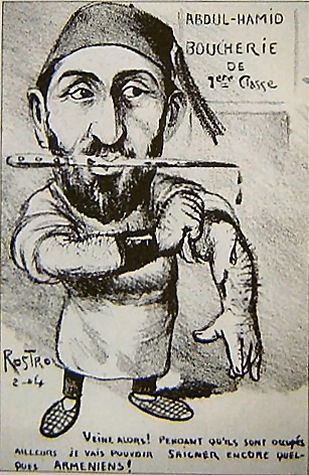
In 1876, 34-year-old
Abdul-Hamid II became
the Sultan. Soon after taking power, he issued the first Imperial
constitution on December 23, 1876. This constitution had been
originally drafted by the grand vizier,
Midhat Pasha. It allowed
equal judicial rights for all citizens, and initiated a two-house
parliament. Abdul-Hamid preferred to rule as a despot and when the
Russo-Turkish war started he dismissed Pasha in February 1877, and
in 1878 he abolished the constitution.
The Russian conflict ended with
Immediately before Abdul-Hamid's
reign, the Armenians had lived peaceably under Ottoman rule. As
Christians, they were second-class citizens and had to pay the "jizya"
tax, but they were not regarded as subject to persecutions. In 1856
an edict called the
Hatti Humayoun, issued
by Sultan Abdul Medjid in 1856, guaranteed Christians rights never
seen before under the Ottomans. Armenians wanted to be granted more
freedoms under the Treaty of Berlin, which saw Batum (modern
With these conditions not
fulfilled, a radical group known as the Huntchagists emerged among
the various Armenian populations, who lived in scattered locations
in
The American missionaries were
allowed in central
In 1896, Reverend Edwin Munsell
Bliss published a book called
Turkey and the Armenian Atrocities.
He acknowledged the destructive elements of the Huntchagists, (page
336) and later noted that some
revolutionaries, whether Huntchagists or not, sought to draw
attention to their aims of a separate state. On January 5, 1893,
placards were erected in Marsovan and Yuzgat, and indiscriminate
arrests followed. Disturbances ensued in Yuzgat, Gemerek, Cesarea,
and elsewhere, and the Turkish authorities reacted punitively,
rounding up and torturing suspects. The polarization of communities
had begun in earnest.
Rumors of a Hutchagist presence led
to the Sassoun massacre, the first of the major atrocities against
Armenian villagers. An
investigative report
into these massacres claimed (page 14) that Armenian Christians were
being subjected to forcible conversions to Islam. In January, 1896
the local Ottoman authorities in Kharpout and Diarbekir told
"converted" villagers that they should not admit to being Muslim if
questioned. Conversions were happening in the provinces in Siras,
Kharpout, Diarbekir, Betlis and Van. Priests and pastors lived in
hiding, lest they be attacked for interfering with the forcible
conversion of villagers. In 28 villages in the district of Kharpout,
there had been no Christian worship since November of 1895.
"Another indirect method of
destroying the Christian communities in the provinces lay in the
systematic debauching of Christian women as though to destroy their
self-respect and undermine their religious ethic. At Tamzara in the
district of Shaska Kara Hussar, in the
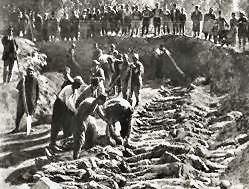
On
October 1, 1895 200
Armenians tried to make a protest in
On
November 11, 1895 the
British missionary Helen B. Harris
wrote on April 24, 1896
from the
There were more massacres at that
time, and in many cases Armenian men were forced to convert or die.
In Birejik in
January 1896, about 96
men converted to Islam, and an equal number were killed. When one
elderly man refused to convert to Islam, live coals were placed on
his body. As he lay in pain, a Bible was held over him, and his
tormentors asked him to read the passages of salvation that he had
trusted in.
In the summer of 1896 one event
took place which would instigate a catastrophic crackdown on the
Armenian population of
The raiders intended to draw
international attention to the plight of Armenians in
The massacres at the end of the 19th
century, which were carried out with the connivance and approval of
Sultan Abdul-Hamid II, are collectively known as the Hamidian
massacres. In 1896, Abdul-Hamid was chastened by international
condemnations, and his orders to attack and forcibly convert
Armenians stopped. The attacks lessened, but only for a while. Soon,
another campaign of massacres would take place. This campaign was
instigated not by Abdul-Hamid but by a new breed of Turkish
political activists, who would go on to commit the genocide of 1915.
These activists were known as the Young Turks.
Sultan Abdul-Hamid II ruled in an
autocratic fashion, fearful of the breakup of his empire. He
employed a secret police force, and rebellious Kurds were drafted as
irregulars into the Hamidian Cavalry. These had been involved in the
massacres of Armenians in the 1890s.
While Abdul-Hamid isolated himself
with astrologers and favorites in his palace, the Yildiz Koshku,
a nationalist movement, started to grow amongst the intelligentsia
and the military. Influenced by Western political ideals, these
individuals became known by the name they used in a revolution waged
against Abdul-Hamid in 1908 ??? the Young Turks.
These individuals emerged in the
1890s but operated in secret, out of fear of the spies of the palace
secret police. Many of the Young Turks joined the nationalist group
the Committee of Union and Progress (Ittihad ve Terakki Jemiyeti
or CUP). This was formed in
1889 at the
As one of the Sultan's three
cabinet members, the loss of Pasha weakened the autocracy of Abdul-Hamid.
Pasha manipulated the Sultan with
fake bomb plots which
were blamed on Armenians. Even after his exile, he was suspected of
engineering a fatal
bomb attack against a
former Armenian ally, Andon Keutchoglu.
In July 1908, the Young Turks
staged a revolution against Abdul-Hamid II. Two prominent CUP
members led the uprisings amongst the military ??? Niazi Bey led a
revolt at Resna in
The Sultan (who was also Caliph)
did not approve of a parliament making decisions, and with the help
of the ulemas (senior clerics), he tried to mount a
counter-revolution on April 13, 1909 (March 31st in the
Gregorian calendar) in
For Armenians, the 1908 Young Turk
revolution promised them full citizenship and a role in the voting
process, and many supported it. As explained by
Yeghiazar Karapetian, a
survivor of the 1915 genocide:
"The Hurriyet (
The Armenians' hopes were never
fulfilled, as there had always been nationalist factions within the
Young Turk movement that saw Armenians as enemies of "Turkishness."
In 1896, many Muslims arrested after the
At the time of Abdul-Hamid's
counter-revolution, resentment among his followers in the army
boiled over in Circassia, southeastern
"Conditions both in
Later, she would write of the
massacres in a book,
The Red Rugs of Tarsus.
She would record (pages
115-116) incendiary shells being fired at
Armenian houses in
"By opening our shutters
cautiously we could hear the cruel hiss of the flames and smell
kerosene in the smoke. Then the rending and crashing of the floors
made a deafening noise, and the sparks began to alight on our
property.
This is the regular order of
things, -- kill, loot, burn. The Armenian quarter is the most
substantial part of the city. Most of the people store cotton on the
ground floor, and this, together with liberal applications of
kerosene, served to make a holocaust. Now at evening-time we realize
our own imminent danger."
In April 1912, an election saw the
CUP gain power, but a military defeat in a conflict with
Deportations and Massacres
The new leadership decided to
consolidate
The policies of enforcing
Turkishness began with deportations. In
early 1914, Mahmut Celal,
the secretary of the CUP in
The presence of the Armenians was
seen by the triumvirate, particularly by interior minister Mehmet
Talaat, as an impediment to their plans to "Turkify" the nation of
Beginning in the spring of 1915,
the deportations of Armenian villagers began. Their ultimate
destination was to be the deserts of northern
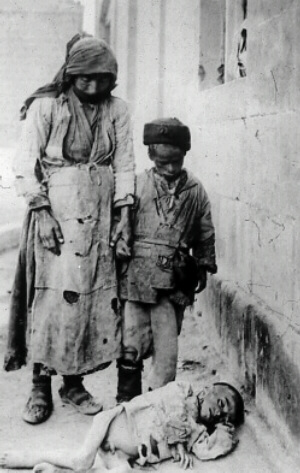
The
personal accounts of
survivors of these forced marches are heartbreaking, especially as
most of these survivors had been children when they were uprooted.
Poignantly, many express nostalgia for rustic lives on farms and
orchards before witnessing horrors of massacres, and forced
deportations.
Aghvani was six years
old when she was expelled from a neighbor's house where she, her
siblings and mother had sought sanctuary in Bitlis:
"We came out; the corpses of
the killed Armenians were everywhere; they had massacred all the
Armenians. Those who were still alive, were driven we didn't know
where. On the road there was confusion and uproar. The Turkish
gendarmes drew us forward with bayonets. At night they came and took
away the young women and girls. One day they took away my mother,
too, and then they brought her back. It was good that my father was
not alive and didn't see himself dishonored."
Shogher Abraham Tonoyan
was born in 1901 in Vardensis village in Mush. In August 1915:
"The Turkish askyars
(policemen) brought Chechen brigands from Daghestan to massacre us.
They came to our village and robbed everything. They took away our
sheep, oxen and properties. Those who were good-looking were taken
away. My aunt's young son, who was staying with me, was also taken
away, together with all the males in the town. They gathered the
young and the elderly in the stables of the Avzut village, set fire
and burned them alive. Those cattle-sheds were as large as those of
our collective farms. They shut people in the stables of Malkhas
Mardo, they piled up stacks of hay round them, poured kerosene and
set on fire. Sixty members of our great family were burned in those
stables. I do not wish my enemy to see the days I have seen, lao!
Only I and my brother were saved. From the beginning, they took away
the young pretty brides and girls to turkize them and also they
pulled away the male infants from their mothers' arms to make them
policemen in the future. The stable was filled with smoke and fire,
people started to cough and to choke. Mothers forgot about their
children, lao! It was a real
The account of
Souren Sargsian (born in
1902), is rich in detail. He described how the total eclipse of the
sun on
August 21, 1914 (Julian
calendar) was seen as a portent of doom. Ismail Enver Pasha
(pictured) minister of war, visited his
In late April 1915, Sargsian???s
mother was gang-raped by Turkish gendarmes, and then his sister, as
his family had given shelter to an Armenian politician. Soon, all
the fit adult men in the village were slaughtered on the orders of
the Ottomans, leaving only a few old men. Orders came for
deportation, but before they left, the soldiers promised that if
they were given gold, they would bring back prisoners from the town.
"A gendarme, a huge notebook in
his hand, was supposedly writing down the name of the prisoner, his
address, his age and so on. In a few hours the saddle-bag was almost
filled with money. In the evening they put he saddle-bag on a horse
and went away. The following day they brought a group of men about
20-30 people, surrounded with 10 gendarmes. They brought also the
well-known rich man in town, Khelkhlik. He was very fat and was
seated on a big, white donkey. The people ran forward, expecting to
find their relatives. The gendarmes drew them back and told them to
form a circle. In the center of the circle, the chief of the
gendarmes fired at Khelkhlik behind his ear. The man fell down
bleeding severely, grunting and shuddering. The gendarmes laughed
whole-heartedly, and the people were silent, horror-stricken. Then
they brought forward the others, every five-six men hugging each
other and they fired at them, then they struck them on the head with
clubs until they lay dead, then they threw them into the torrent and
went away."
His descriptions of the journey,
passing rivers filled with the bloated bodies of women, stripped
naked and decomposing under the July sun, the raids by Kurds, rapes,
bayonetings and decapitations, are gruesome, but they illustrate
clearly how dehumanizing the deportation process was.
In
The sending of this, and other
similar telegrams, was later denied by Mehmet Talaat. The primary
source for these telegrams is a work called ???Memoirs of Naim Bey,???
written by Aram Andonian and published in 1920. There is some doubt
as to the
authenticity of these purported telegrams. It
has been argued by some that once the "smoking gun" of these
telegrams is removed, claims of "genocide" cannot be made about what
happened to the Armenians. This is not true. The definition of
genocide as laid out by the United Nations in 1948 is "to destroy,
in whole or in part, a national, ethnic, racial or religious group."
Purgings of an entire ethnic group
from a nation are de facto genocidal. Dr Tessa Hofmann of
the Free University of Berlin
stated that in modern
According to a
British government report,
which was published in 1915 by Lord James Bryce while the genocide
was still taking place, the Turkish government directly ordered at
least one 1915 massacre:
"Orders came from
Constantinople that all the Armenian Christians in Trebizond (
Obeying the orders which they
had received, they hunted out all the Christians, gathered them
together, and drove a great crowd of them down the streets of
Trebizond, past the fortress, to the edge of the sea. There they
were all put on board sailing boats, carried out some distance on
the Black Sea, and there thrown overboard and drowned.
Nearly the whole Armenian
population of from 8,000 to 10,000 were destroyed - some in this
way, some by slaughter, some by being sent to death elsewhere.
After that, any other story becomes credible; and I am sorry to say
that all the stories that I have received contain similar elements
of horror, intensified in some cases by stories of shocking
torture."
A German account was written by
Dr. Martin Niepage who
was in
Niepage wrote:
"What
we saw with our own eyes here in
One of them, Herr Greif, of
Other men had their hands tied
behind their back and were rolled down steep cliffs. Women were
standing below, who slashed those who had rolled down with knives
until they were dead. A Protestant pastor who, two years before, had
given a very warm welcome to my colleague, Doctor Graeter; when he
was passing through his village, had his finger nails torn out."
Turkey's German allies who were
aware of the fate of Armenian deportees were advised to stay silent.
One man who disobeyed such orders was German second-lieutenant in
the Sanitary Corps,
Armin T. Wegner, (1886 ???
1978). Wegner was stationed in the
Henry Morgenthau was
"One day I was discussing these
proceedings with a responsible Turkish official, who was describing
the tortures inflicted. He made no secret of the fact that the
Government had instigated them, and, like all Turks of the official
classes, he enthusiastically approved this treatment of the detested
race. This official told me that all these details were matters of
nightly discussion at the headquarters of the
"....The real purpose of the
deportation was robbery and destruction; it really represented a new
method of massacre. When the Turkish authorities gave the orders for
these deportations, they were merely giving the death warrant to a
whole race; they understood this well, and, in their conversations
with me, they made no particular attempt to conceal the fact."
In a
letter to the U.S.
Secretary of State, Morgenthau wrote on July 15, 1915: "Deportation
of and excesses against peaceful Armenians is increasing and from
harrowing reports of eye witnesses it appears that a campaign of
race extermination is in progress under a pretext of reprisal
against rebellion."
Winston Churchill
spoke of the Armenian
genocide in the
It is a shame that in the
The three CUP leaders ??? Ismail
Enver, Mehmet Talaat and Ahmet Cemal ??? along with several minor
officials were tried in
Ismail Enver died fighting the
Soviets in
Most historians accept the events
that began in 1915 as "genocide." In
Occasionally the remains of victims
of the Armenian genocide become
uncovered. In Xirabebaba
in southeastern
The news was published in a Kurdish
newspaper, but Turkish army officials arrived and told the villagers
to cover the entrance to the cave, and claimed that stories that the
bodies were Armenian were "lies." Local police demanded to know who
had leaked the discovery to the press.
Rise of the Young
Turks
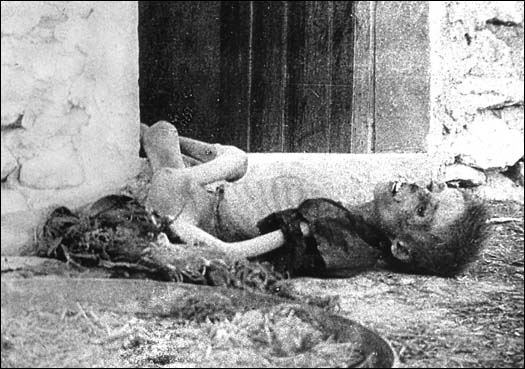
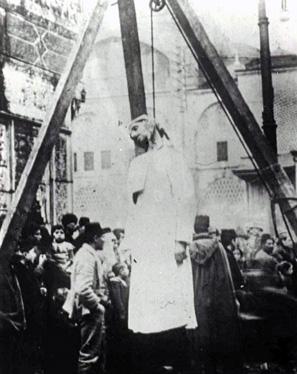


Official Reactions


| If you like this essay: |
Stumble it
 |
digg it |
Adrian Morgan, aka
Giraldus Cambrensis of
Western Resistance, is UK-based writer and artist. He also writes for
Spero News,
Family Security Matters and
Faithfreedom.org.
Name: ExMuslim
Date: Sunday October 21, 2007
Time: 06:59:37 -0700
Comment
It's not genocide but jihad. And jihad, in the cause of Allah, is the highest duty and praiseworthy act for the Ummah of Islam. Why give the noblest of Islamic deed a wrong name, and be ashamed to the infidels of the world?
Name:
Date: Sunday October 21, 2007
Time: 09:43:29 -0700
Comment
I wonder what the Armenians did to be punished this harsh by the falling Othman empire. No one talk about the Armenians cooperation with the Russian to bring down the Othman. Just like no one talks about the Jews and their anti Europeans schemes before the so called Holocaust took place. I wonder if the so called leader of the free world will be accused of massacres, may be only when it collapses and no longer a super power.
Name: Apostate
Date: Sunday October 21, 2007
Time: 19:01:36 -0700
Comment
The Ottoman empire's barbarity should be condemned by only recognizing the "Armenian genocide". It must go all the way to its birth and unearth all the ceaseless barbarity commited by the Jihadists of the regime one after another.
Name: Marie
Date: Monday October 22, 2007
Time: 12:59:18 -0700
Comment
Jewish anti-European Schemes, what Jewish anti-European schemes? Their is no doubt that the Armenian Genocide and the Jewish Holocaust did take place. Just look at the evidence. Obviously the nameless person who made these accusations is a Muslim who is challenging all of the evidence of these atrocities. The only evidence that Muslims use to deny these atrocities is the evidence that only comes out of their mouth. There is no evidence that can prove that the Armenian Genocide and the Jewish Holocaust is a lie and that these atrocities did not occur.
Name:
Date: Thursday November 01, 2007
Time: 07:22:59 -0700
Comment
Name: Turco-Deist
Date: Friday November 02, 2007
Time: 16:09:46 -0700
Comment
I'm not into any muslim crap anymore, but I'm from Turkey and learned this subject from another point of view. You might check out the Turkish recordings and see how many Turks were massacred by Armenian militia. I personally do not think the same as the Turkish state thinks but I cannot think that Armenian diaspora is right about that. Truth is somewhere in between, and both nations suffered. That's what I think.
Name: elegcavn
Date: Friday November 09, 2007
Time: 08:28:02 -0700
Comment
<a href="http://mmwwnwtq.com">wgjczcoi</a> xvritviu http://wqivdzdn.com aonkncab uhisfwqh [URL=http://pthzfrso.com]ovqwapui[/URL